
Hard Floor Maintenance inCommercial Facilities:What “Expert Care” Actually Means
Most commercial buildings apply the wrong floor maintenance protocol for their surface type. Here's what expert hard floor care actually requires by surface type, by cadence, and by cost of getting it wrong.
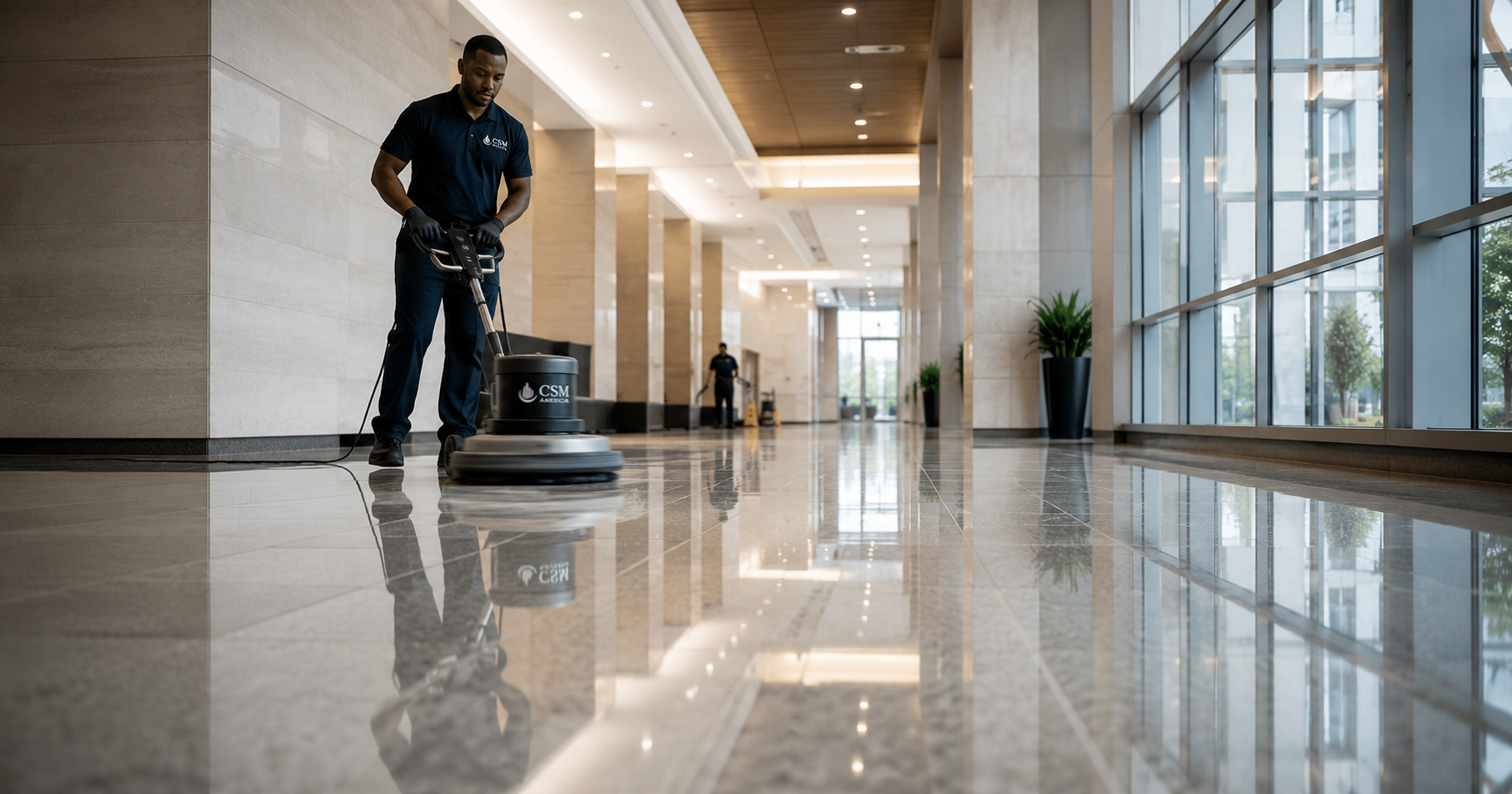
Most commercial facilities have a floor cleaning schedule. Very few have a floor maintenance program. The difference shows up on your balance sheet, not just your floor surface.
Hard floors are one of the highest-cost assets in any commercial facility. VCT, tile, hardwood, polished concrete, epoxy-coated surfaces represent a significant capital investment that most organizations protect with a mop and a bucket.
The result is predictable: premature replacement, escalating repair costs, and facility appearance standards that deteriorate faster than they should. A study of commercial flooring lifecycle costs consistently shows that improper or inconsistent maintenance cuts expected floor life in half or less.
This guide breaks down what expert hard floor maintenance in a commercial facility actually requires, why generic protocols fail by surface type, and what the financial cost of getting it wrong looks like at the 1-, 3-, and 5-year mark. CSM America's full range of Specialized Cleaning and maintenance services are available at csmamerica.com.
Why Generic Floor Maintenance Protocols Fail
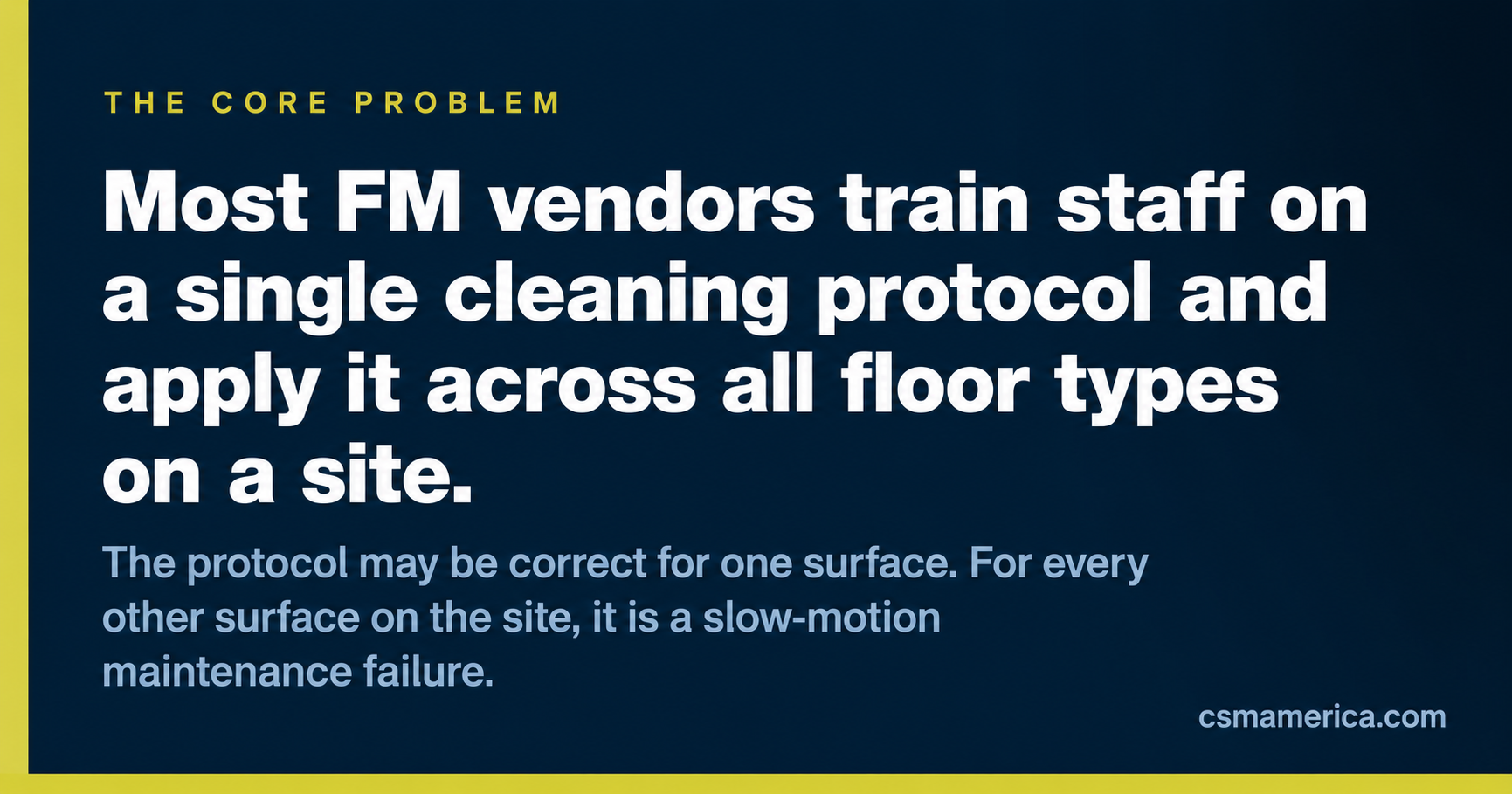
The most common floor maintenance failure in commercial facilities isn't neglect. It's the application of a one-size-fits-all protocol to surfaces that require fundamentally different care.
A mop and a neutral cleaner that works perfectly on ceramic tile will damage a hardwood floor. A high-speed burnisher appropriate for VCT can destroy a polished concrete surface. An alkaline cleaner that cuts grease on an industrial epoxy coating will strip the finish from a sealed hardwood floor in a corporate lobby.
Generic protocols are designed around the lowest common denominator what will work without immediately causing visible damage across multiple surface types. The problem is that "not immediately causing visible damage" and "expert care" are not the same thing.
Surface-by-Surface: What Expert Hard Floor Care Actually Requires
The starting point for any expert floor maintenance program is surface identification. Every commercial facility has a different mix of floor types, and each one requires a specific protocol for daily care, periodic maintenance, and long-term preservation.
VCT (Vinyl Composition Tile) and Vinyl Plank
VCT is the most common commercial floor surface and the most misunderstood. Most vendors treat VCT maintenance as a mopping problem. It is actually a finish management problem.
- Daily: dry dust mopping to remove abrasive particulates that scratch the finish layer.
- Weekly: damp mopping with a pH-neutral cleaner. Alkaline cleaners accelerate finish breakdown.
- Monthly: burnishing or buffing to maintain finish sheen and surface hardness.
- Annually: strip and recoat. The finish layer must be fully removed and reapplied on a documented cycle typically annually in high-traffic environments, every 18 months in moderate-traffic areas.
A VCT floor that is mopped but never burnished and recoated will show traffic lane graying within 6-12 months. A floor that is stripped and recoated on schedule, with daily dust mopping maintained, has a serviceable life of 15-20 years.
Ceramic and Porcelain Tile
Tile is durable but grout is not. The grout lines in any tile installation are porous, absorbent, and magnetically attractive to soil, bacteria, and cleaning product residue. Most commercial tile cleaning programs clean the tile and ignore the grout.
- Daily: dry sweep or dust mop. Surface mopping with a neutral cleaner.
- Weekly: damp mop inspection check grout lines for discoloration and moisture retention.
- Monthly: dedicated grout cleaning with appropriate dwell time and mechanical agitation. Surface mopping does not clean grout.
- Annually: grout resealing in high-traffic and high-moisture areas (restrooms, kitchens, entryways).
Discolored grout is not an aesthetic problem it is a hygiene problem. In healthcare and food service environments, embedded grout contamination is a compliance issue, not just a cleaning failure.
Hardwood and Wood-Look Surfaces
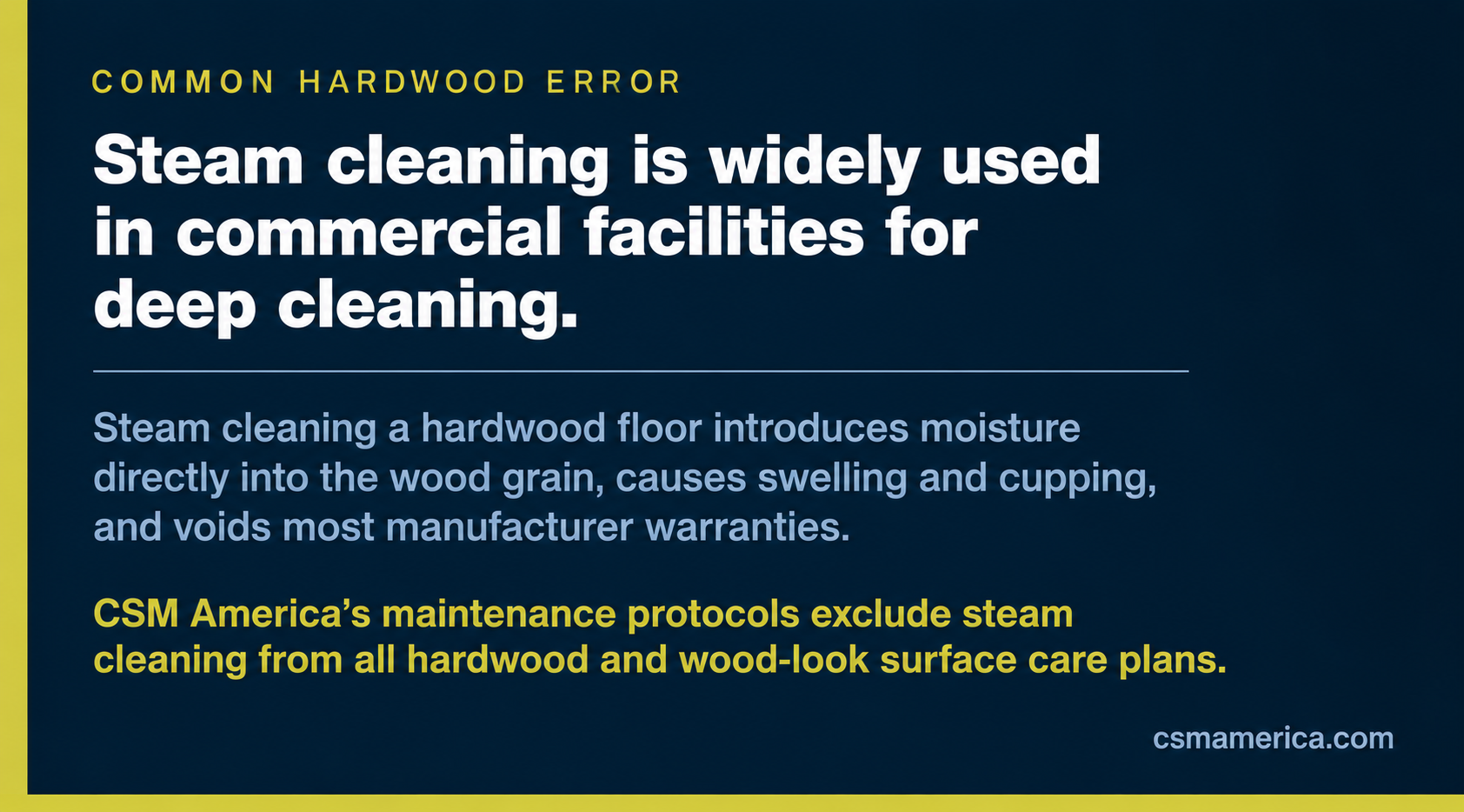
Hardwood floors in corporate lobbies, executive suites, and conference rooms are among the most expensive per-square-foot assets in a commercial facility. They are also the most frequently damaged by well-intentioned but incorrect cleaning.
- Daily: dry microfiber mopping only. Water and hardwood are incompatible at the daily maintenance level.
- Weekly: manufacturer-approved damp mopping with a hardwood-specific cleaner. Wring the mop nearly dry before contact with the surface.
- Monthly: surface inspection for scratches, finish wear, and moisture damage at seams.
- Annually or as needed: professional refinishing if finish wear is significant.
Polished Concrete
Polished concrete has become increasingly common in corporate, retail, and industrial environments. It requires specialized care that differs significantly from other hard floor types.
- Daily: dust mopping with a microfiber pad. Polished concrete attracts fine particulates that act as abrasive agents if left in place.
- Weekly: damp mopping with a pH-neutral cleaner. Acidic or alkaline cleaners etch the surface.
- Quarterly: application of a concrete densifier or guard product to maintain surface hardness.
- Annually: repolishing and guard reapplication based on traffic volume and surface wear.
Epoxy-Coated and Specialty Floors
Industrial and warehouse environments often feature epoxy-coated concrete floors. These are highly durable but require specific care to preserve the coating integrity.
- Daily: soft sweeping or dust mopping. Abrasive scrubbers damage the epoxy surface.
- Weekly: damp mop with a non-abrasive, non-alkaline degreaser.
- Monthly: inspection for chips, cracks, and delamination these are moisture entry points.
- As needed: spot recoating of damaged areas before moisture compromises the substrate.
The Surface-by-Surface Maintenance Reference
The following table summarizes the correct maintenance cadence by surface type for commercial facilities:
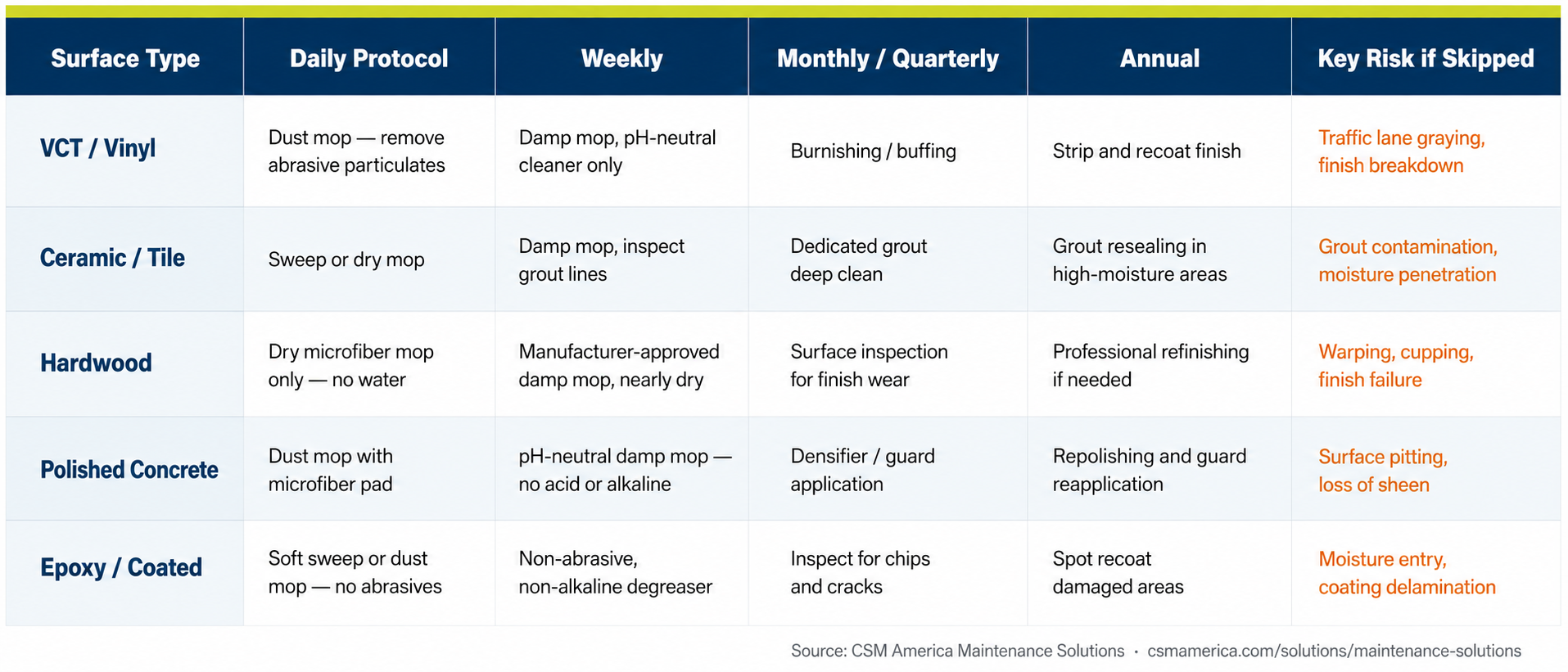
This table is a starting point. Every facility has unique traffic patterns, occupancy schedules, and compliance requirements that should be reflected in a site-specific maintenance plan.
The Cost of Deferred Floor Maintenance At 1, 3, and 5 Years
Deferred floor maintenance is not a cost savings. It is a cost deferral with interest. The table below illustrates what happens to each major surface type when proper maintenance protocols are not followed.
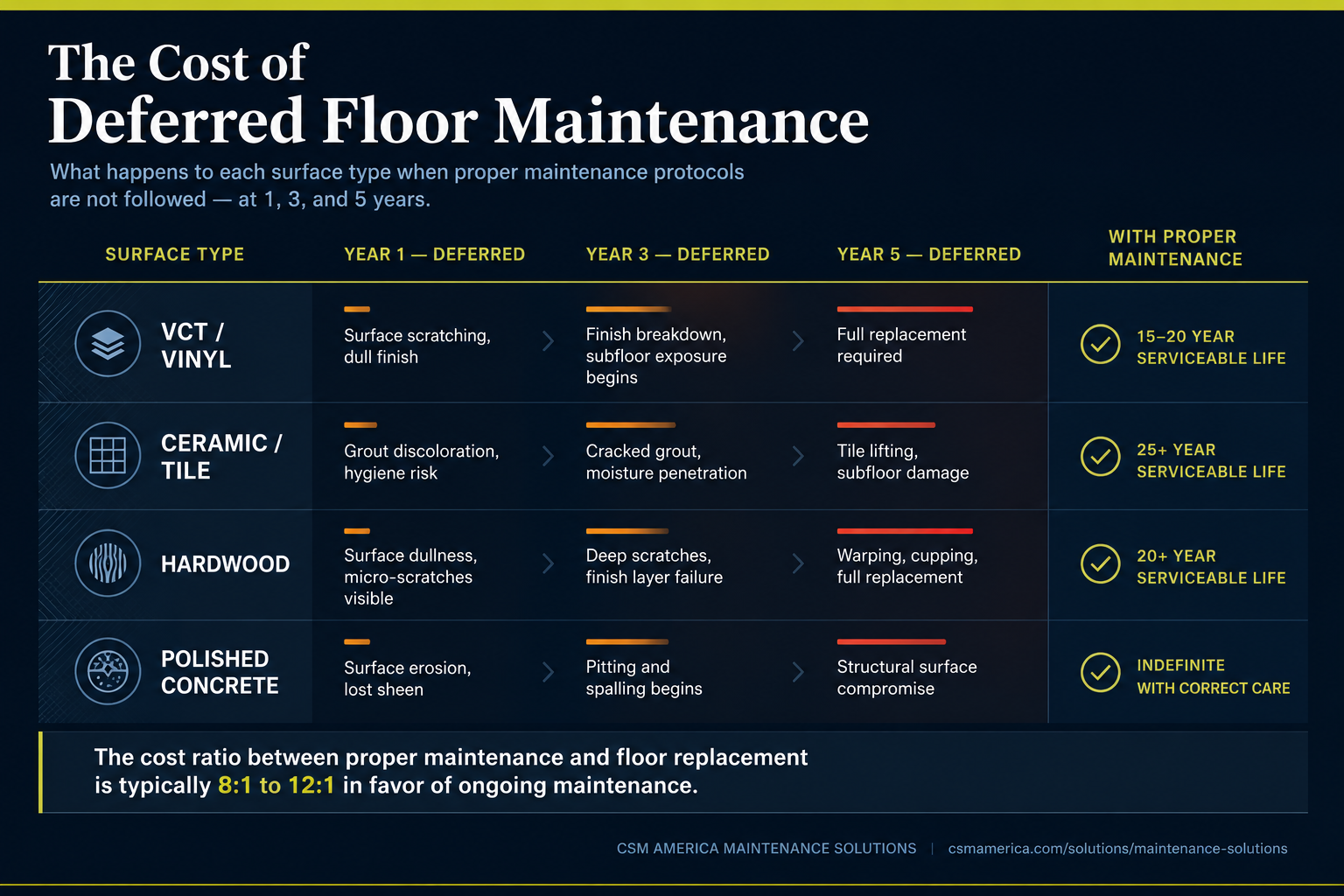
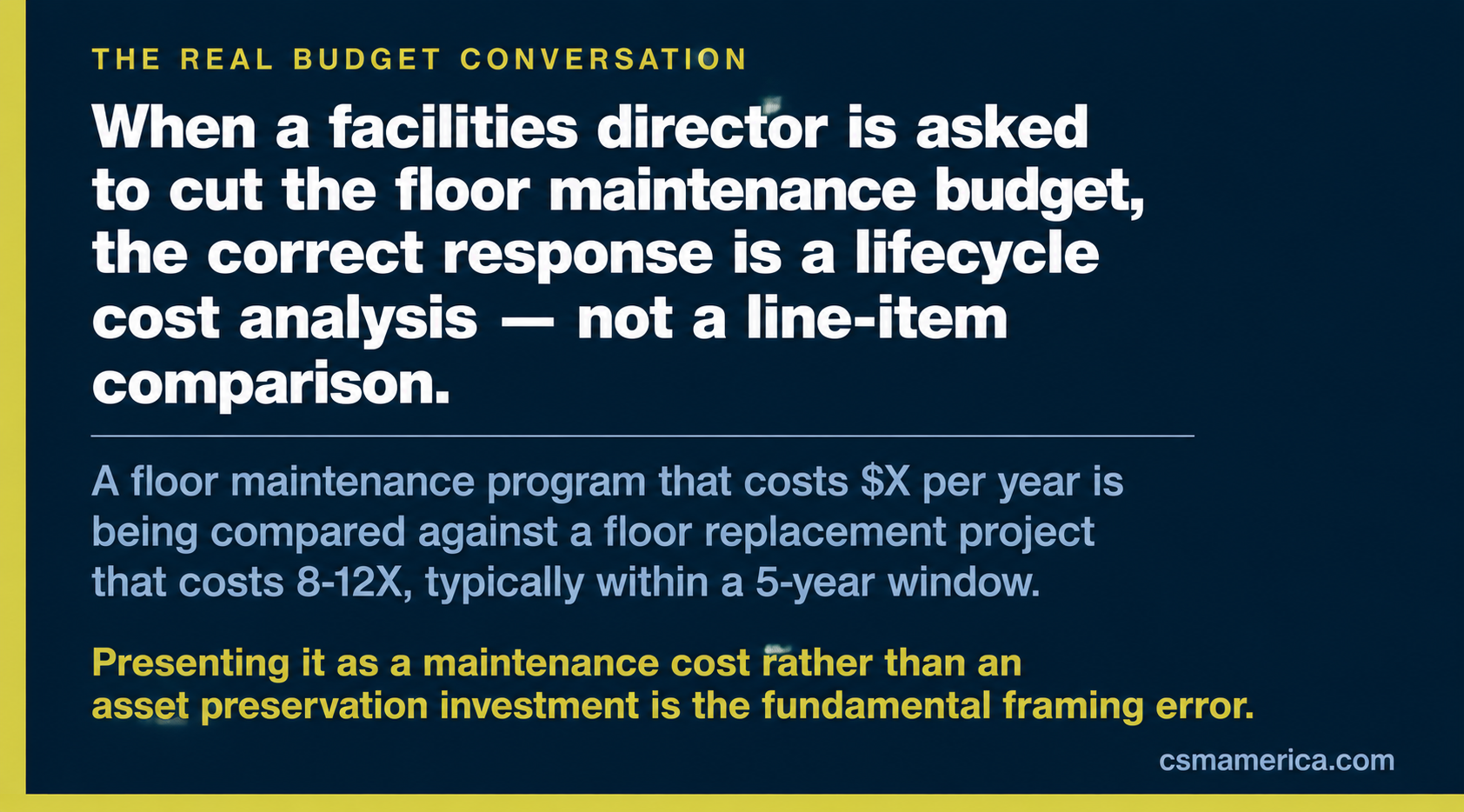
The pattern across all surface types is the same: deferred maintenance that feels like a budget saving in year one becomes a capital replacement project in year five. The cost ratio between a proper maintenance program and eventual floor replacement typically runs 8:1 to 12:1 in favor of ongoing maintenance.
What to Require from Your FM Partner's Floor Maintenance Program
If your current facility management partner or janitorial vendor is responsible for your hard floor care, ask these specific questions before your next contract review:
- 01 Do you have a site-specific floor maintenance plan that identifies each surface type in our facility?
- 02 What is the strip-and-recoat schedule for our VCT floors, and is it documented in the contract?
- 03 How are your staff trained on surface-specific protocols specifically, what training is provided on hardwood vs. tile vs. VCT?
- 04 What grout cleaning protocol do you use, and how frequently is it applied in our restrooms and high-moisture areas?
- 05 Can you provide documentation of the products used on each surface type and verify they are manufacturer-approved?
- 06 What is your process for identifying and flagging floor damage before it escalates to a repair or replacement event?
A vendor who cannot answer these questions specifically is not operating an expert floor maintenance program. They are operating a cleaning schedule which is not the same thing. If your current vendor is falling short, request a free site assessment from CSM America.
How CSM America Approaches Hard Floor Maintenance
CSM America's Maintenance Solutions service line provides hard floor maintenance and repair for hardwood, tile, and vinyl surfaces across commercial, corporate, aviation, and healthcare environments. Our approach is built on three principles that align directly with verified content from csmamerica.com:
Tailored solutions: every maintenance plan is built around your specific surface types, traffic volumes, and compliance requirements. We don't apply a standard protocol across a facility with multiple floor types.
Sustainable methods: our floor care practices use environmentally friendly products and techniques that deliver exceptional results while protecting indoor air quality and reducing harsh chemical exposure for your team and your building's occupants.
Preservation-focused: our goal is to extend the serviceable life of your floor investment, not just maintain its appearance. Every maintenance decision is made with lifecycle cost in mind.
We also provide hard floor repair services addressing damage before it requires full replacement, and working with facility directors and property managers on proactive repair schedules that protect the floor asset and avoid unplanned capital expenditure.
Frequently Asked Questions
How often should commercial VCT floors be stripped and recoated?
In high-traffic commercial environments offices, healthcare facilities, retail VCT should be stripped and recoated annually. In moderate-traffic areas, an 18-month cycle is generally appropriate. The correct cadence depends on your facility's specific traffic volume, occupancy schedule, and the number of finish coats applied at installation. A proper maintenance program includes documentation of when each floor area was last stripped and recoated.
Is it safe to use steam cleaning on commercial hard floors?
Steam cleaning is appropriate for some ceramic tile surfaces, but it should never be used on hardwood, wood-look vinyl, or polished concrete. The moisture introduced by steam cleaning damages wood grain, causes swelling and cupping in hardwood floors, and can compromise polished concrete surface coatings. Any FM vendor recommending steam cleaning for hardwood or wood-look surfaces should be asked to confirm the manufacturer's warranty position on steam exposure.
What is the difference between buffing and burnishing?
Buffing uses a low-speed machine (175-350 RPM) with a spray application to clean and restore the floor finish. Burnishing uses a high-speed machine (1500-3000 RPM) to generate heat that hardens and seals the finish layer, producing a high-gloss result. Buffing is appropriate for regular maintenance. Burnishing is for finish restoration and is typically done monthly or quarterly. Not all floor surfaces are appropriate for burnishing hardwood, polished concrete, and some vinyl surfaces should not be burnished.
How do I know if my floor maintenance program is working?
Three observable indicators: finish sheen consistency across the entire floor surface (not just high-visibility areas), grout line color consistency in tile areas (discoloration is a maintenance failure signal), and the absence of traffic lane graying in carpet or VCT areas. A floor maintenance program that is working should produce a floor that looks the same in year three as it did in year one. If your floor's condition is visibly declining, the maintenance program is not sufficient for your facility's traffic volume.
Stay Updated with Our Insights
Get a tailored solution for your maintenance needs with our expert services.

- Company Info
- About Us
- Careers
- News & Resources
- Support Links
- Contact
- FAQ
- Sitemap
- NAVEX
- Uniform Ordering